X
Receive information tailored to you
X
Leave your details below and one of our specialists will contact you shortly to provide more information and answer any questions.
When people think about trailer performance, they often focus on visible features like bed size, load capacity, or overall design. But some of the most important performance factors are found underneath the trailer.
Your trailer’s running gear—including its tires, axles, suspension, and bearings—plays a major role in how it carries weight, handles the road, and performs over time. These are the components that support safe hauling, help distribute the load, and influence how stable and reliable the trailer feels behind the truck.
In this guide, we’ll take a closer look at the parts of a trailer that do the hard work from the ground up, and why understanding them matters when you rely on your equipment day after day.
Your running gear is the foundation of your trailer’s performance. It affects more than movement—it influences load support, ride quality, tire wear, stability, and overall control.
When these components are properly matched and maintained, the trailer feels more predictable and capable under load. When something is off—whether it’s tire pressure, axle alignment, or bearing condition—the trailer can start showing signs long before a major problem appears.
That is why running gear matters so much. It helps deliver the heavy-duty capability your trailer was built for, and it plays a direct role in safe towing.
Tires are one of the simplest parts of a trailer to overlook, but they are one of the most important. Proper tire pressure is not just about tire life—it is a major part of safe hauling and correct load distribution.
One of the most important habits is to always check PSI when the tires are cold. Even a short drive can heat the air inside the tires and raise the PSI, giving you a reading that does not reflect the tire’s true cold pressure.
It is also important to inflate based on the Trailer Certification Placard (VIN tag), not the maximum PSI listed on the tiresidewall. The placard reflects the correct pressure for that specific trailer model and its intended load support.
When tire pressure is ignored, the cost shows up quickly. Under-inflation can generate excess heat, increase wear, and raise the risk of a blowout—especially on trailers built to carry heavy loads.
Tire wear is not just wear—it is also a clue. Uneven patterns can point to inflation problems or even alignment and axle issues. That makes your tires one of the easiest places to spot early warning signs.
Here is a simple guide:
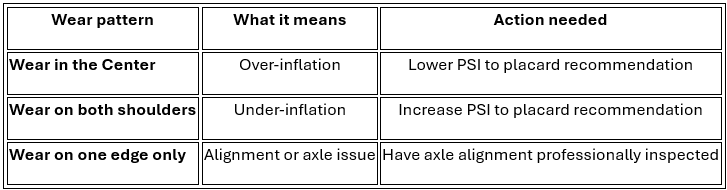
Patterns like these can tell you a lot before performance and safety begin to suffer. Paying attention to tire wear can help you catch issues earlier and keep your trailer working the way it should.
Axles do more than hold the wheels in place. They are one of the main structural points that carry the trailer’s weight and help determine how that weight is supported on the road.
Suspension works alongside the axle to manage movement, absorb bumps, and improve ride quality. Together, these components shape how the trailer responds to rough pavement, uneven ground, and repeated heavy use.
Many trailers use one of two common suspension styles:
The right setup depends on how the trailer will be used, what kind of loads it will carry, and what type of ride or maintenance profile the owner prefers.
Wheel bearings are easy to forget because they are out of sight—but when they fail, they quickly become impossible to ignore. In fact, bearing failure is one of the leading causes of roadside trailer breakdowns.
That is why regular greasing matters. Following the manufacturer’s maintenance recommendation helps protect the bearings and keeps the hubs functioning properly. If a trailer uses an EZ Lube or similar system, itis also important not to over-grease, since too much pressure can damage the rear seal.
A few warning signs are worth paying attention to. Grinding or clicking noises, unusual resistance, or one hub that feels noticeably hotter than the others after a stop can point to a bearing or brake issue that needs attention. Catching that kind of problem early can prevent bigger damage later.
Tires, axles, suspension, and bearings are all part of the same system. They do not affect trailer performance separately—they affect it together.
For example, the right tire pressure helps the axles and suspension carry the load correctly. Good suspension helps reduce stress across the trailer and tires. Healthy bearings allow the wheels to turn smoothly and safely under that load. When one part is not performing as it should, the effects often show up somewhere else.
That is why a strong trailer is not just about what you see from the side. It is also about what is happening underneath, every mile down the road.
When you rely on your trailer for serious hauling, running gear is not a small detail—it is part of what makes the trailer work the way it was designed to work.
Understanding how tire pressure, tire wear, axle setup, suspension type, and bearing condition all contribute to performance helps you make better decisions as an owner and buyer. It also helps explain why a trailer that is built right from the ground up can feel more stable, tow more confidently, and hold up better over time.
If you are comparing equipment this season, do not stop at size and payload. Take a closer look at what supports the trailer underneath. That is where a bigpart of long-term performance begins.
For trailers built for demanding work from the ground up, explore the Iron Bull and Norstar lineup and find the setup that fits the way you haul.