X
Receive information tailored to you
X
Leave your details below and one of our specialists will contact you shortly to provide more information and answer any questions.
When choosing a trailer, most people focus on size, capacity, and price. But there’s another factor that plays an important role in how a trailer performs: its Braking Setup.
At first glance, it’s easy to assume that more axles automatically mean more braking. In practice, trailer configurations don’t always work that way—and understanding why can help you make a better decision.

One common assumption is that every axle on a trailer includes brakes. In reality, brake configuration depends on how the trailer is built and what it’s intended to do.
Some trailers include brakes on every axle, while others may have brakes on only one axle—even if they have two or more. This can vary depending on the trailer’s design, weight, and application.
This doesn’t mean one setup is better—it simply reflects how the trailer is configured for its intended use.
Brake configuration is influenced by a combination of factors, including trailer weight, design, and applicable guidelines.
GVWR refers to the maximum total weight a trailer is designed to carry, including its own weight and payload. This rating is one of the factors considered when defining how a trailer is configured for braking.
Different trailers are designed for different types of work. A light-duty utility trailer may not require the same braking setup as a heavy-duty Equipment or Dump Trailer.
In the United States, trailer brake requirements are influenced by a combination of federal safety standards and state-level transportation guidelines. These guidelines often define when trailer brakes are required based on weight thresholds defined by state regulations. Because of this, brake requirements can vary depending on where a trailer is operated.
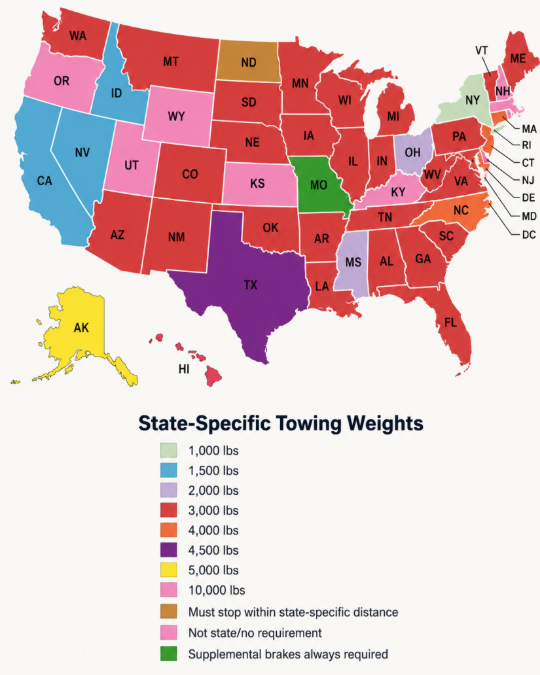
While the general principles are similar, brake requirements can vary across the country. The map below helps illustrate how these differences may apply depending on where a trailer is operated.
The values shown in the map represent general weight thresholds (in pounds) at which trailer brakes may be required. While this map reflects broader towing-related guidelines, it helps illustrate how brake-related requirements can vary by state.
Brake axles are only one part of the overall setup. Trailers can be equipped with different types of braking systems, such as electric or hydraulic brakes, depending on the application. Suspension systems can also vary, influencing how the trailer handles weight and road conditions.
As a result, two trailers with the same number of axles can perform differently depending on how they are configured.
Selecting the right trailer involves more than comparing sizes or capacities.
It’s important to consider:
In some cases, a lighter configuration may be appropriate. In others, additional braking capability may be needed.
Understanding these differences helps ensure the trailer matches the intended application, not just on paper, but in real-world use.
At Norstar, trailer configurations are designed with real-world applications in mind.
That means considering how trailers are actually used—across different industries, load types, and operating conditions—and aligning key components like braking systems, suspension, and overall build to support that use.
Rather than a one-size-fits-all approach, the goal is to provide configurations that match the demands of the job.